
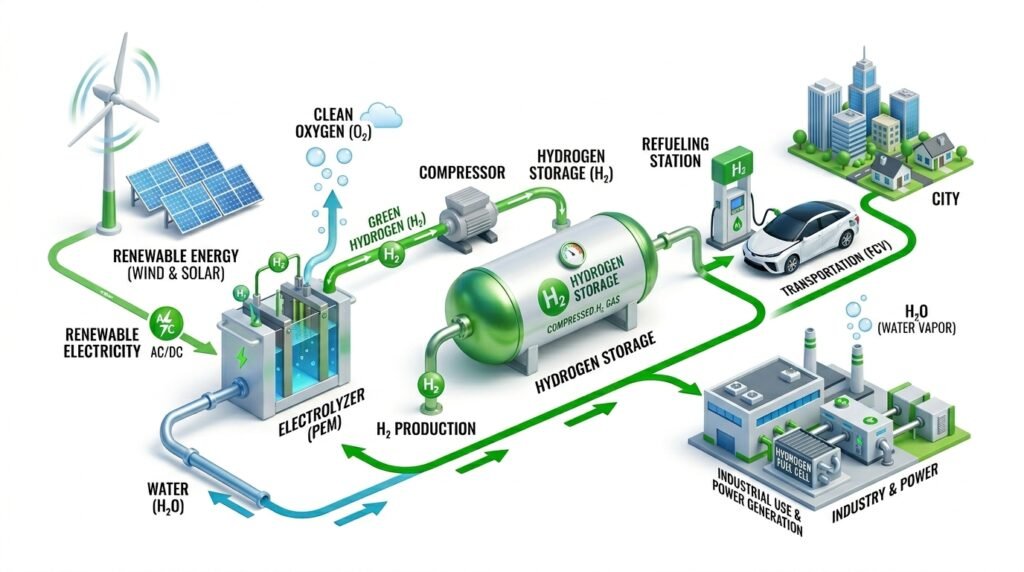
Green hydrogen is rapidly emerging as one of the most promising clean energy solutions of our time. Understanding how green hydrogen is produced helps clarify why governments, scientists, and industries are investing heavily in this sustainable fuel. At its core, green hydrogen is created using renewable electricity and a process called electrolysis, which splits water into hydrogen and oxygen without releasing harmful carbon emissions.
What Is Green Hydrogen?
Green hydrogen is hydrogen gas produced entirely from renewable energy sources such as solar, wind, or hydropower. Unlike grey or blue hydrogen, which rely on fossil fuels, green hydrogen produces zero carbon emissions during production. This makes it a truly clean fuel capable of powering vehicles, heating homes, and supporting heavy industries like steel and cement manufacturing.
How Green Hydrogen Is Produced Through Electrolysis
The key to understanding how green hydrogen is produced lies in electrolysis. Electrolysis is an electrochemical process that uses electricity to break water (H₂O) into its two components: hydrogen (H₂) and oxygen (O₂).
The process works inside a device called an electrolyzer, which contains two electrodes — a positively charged anode and a negatively charged cathode — separated by an electrolyte. When renewable electricity flows through the water, the following reactions occur:
- At the cathode: Water molecules gain electrons, producing hydrogen gas.
- At the anode: Water molecules lose electrons, producing oxygen gas.
The hydrogen gas is then collected, stored, and used as fuel, while the only byproduct is harmless oxygen released into the atmosphere.
Types of Electrolyzers Used in Production
Several electrolyzer technologies make green hydrogen production possible:
- Alkaline Electrolyzers – A mature, cost-effective technology widely used for large-scale production.
- PEM (Proton Exchange Membrane) Electrolyzers – Compact and highly efficient, ideal for variable renewable energy.
- Solid Oxide Electrolyzers – Operate at high temperatures and offer excellent efficiency, though still developing commercially.
Each type plays a role in scaling up clean hydrogen depending on cost, efficiency, and energy availability.
Why Renewable Energy Matters
What truly defines green hydrogen is the source of electricity. When the power driving electrolysis comes from solar panels or wind turbines, the entire process remains carbon-free. This distinguishes green hydrogen from other types and makes it a cornerstone of the global transition toward net-zero emissions.
Benefits of Green Hydrogen
Green hydrogen offers numerous advantages:
- Zero carbon emissions during production and use
- Energy storage capability for excess renewable power
- Versatility across transportation, industry, and power generation
- Long-term sustainability as renewable energy becomes cheaper
Challenges and the Road Ahead
Despite its promise, green hydrogen faces challenges, including high production costs, the need for abundant renewable electricity, and infrastructure development. However, as technology advances and renewable energy prices fall, green hydrogen is expected to become increasingly affordable and widely adopted
Conclusion
Understanding how green hydrogen is produced reveals why it is considered a game-changer for clean energy. Through electrolysis powered by renewable electricity, water is transformed into a versatile, emission-free fuel. As innovation accelerates, green hydrogen stands ready to play a vital role in building a sustainable, low-carbon future for generations to come.