
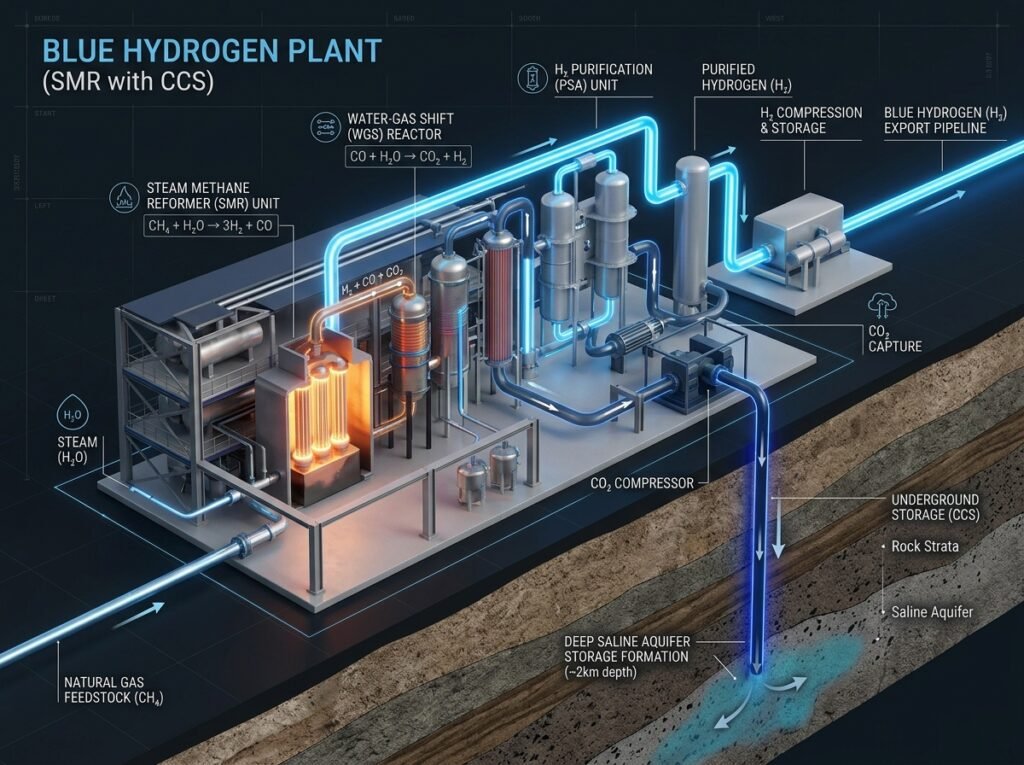
Blue hydrogen is rapidly emerging as one of the most significant forces reshaping the global energy landscape. As nations race to decarbonize their economies while maintaining energy security, blue hydrogen offers a pragmatic bridge between today’s fossil-fuel-dependent systems and a cleaner, more sustainable future. By combining established natural gas infrastructure with carbon capture technology, this energy carrier is unlocking new possibilities for industries that have long been considered difficult to decarbonize
What Makes Blue Hydrogen a Game-Changer
Blue hydrogen is produced primarily through steam methane reforming (SMR) or auto-thermal reforming of natural gas, paired with carbon capture, utilization, and storage (CCUS) technology. This process captures up to 90 percent of the carbon dioxide emissions that would otherwise be released into the atmosphere. The result is a low-carbon fuel that retains the scalability and affordability of conventional hydrogen production while dramatically reducing its environmental footprint.
What distinguishes this approach from green hydrogen—produced via renewable-powered electrolysis—is its cost-effectiveness and immediate scalability. While green hydrogen remains the long-term ideal, the technology and renewable capacity required to produce it at scale are still maturing. This is precisely where blue hydrogen fills a critical gap, allowing economies to begin decarbonizing today rather than waiting decades for fully renewable solutions.
Transforming Heavy Industry and Manufacturing
The industrial sector accounts for a substantial portion of global carbon emissions, and sectors such as steel, cement, ammonia, and chemical manufacturing are notoriously hard to abate. Electrification alone cannot solve their high-temperature heat and feedstock requirements. Here, low-carbon hydrogen is proving transformative.
Steel producers are increasingly exploring hydrogen-based direct reduction processes to replace coal-fired blast furnaces. Ammonia plants, which already use hydrogen as a feedstock, can transition to cleaner production methods with minimal disruption to existing operations. By integrating this fuel into their processes, manufacturers can slash emissions without abandoning the assets and supply chains they have built over generations.
Reshaping Power Generation and Grid Stability
Beyond industry, hydrogen is influencing how the world generates and stores electricity. Power plants can blend hydrogen with natural gas or burn it directly in modified turbines, producing dispatchable electricity with significantly lower carbon output. This capability is invaluable for grid operators managing the intermittency of solar and wind power.
When renewable generation exceeds demand, surplus energy challenges grid stability. Hydrogen offers a storage medium that can hold energy for extended periods, releasing it when needed. This positions hydrogen as a vital tool for balancing increasingly renewable-heavy grids and ensuring reliable power delivery around the clock.
Driving Infrastructure Investment Worldwide
One of the most compelling aspects of this energy transition is the wave of infrastructure investment it is catalyzing. Governments across Europe, Asia, the Middle East, and North America are committing billions toward hydrogen hubs, pipelines, and carbon storage facilities. Countries with abundant natural gas reserves and suitable geological formations for carbon storage—such as the United States, Canada, Norway, and the Gulf states—are positioning themselves as future export leaders.
These investments are creating entirely new value chains, generating jobs, and stimulating innovation in carbon capture and storage technologies. The existing pipeline networks and gas processing facilities can often be repurposed, reducing the capital required and accelerating deployment timelines.
Enabling Clean Transportation
The transportation sector is another frontier where hydrogen is making meaningful inroads. Heavy-duty trucking, shipping, and aviation face significant hurdles in adopting battery-electric solutions due to weight, range, and refueling constraints. Hydrogen fuel cells and hydrogen-derived synthetic fuels offer viable alternatives for these demanding applications.
As refueling infrastructure expands, long-haul logistics companies and maritime operators are beginning to pilot hydrogen-powered fleets. This shift could substantially reduce emissions in segments of transport that have remained stubbornly resistant to cleaner technologies.
Addressing Challenges and Criticisms
Despite its promise, this technology is not without controversy. Critics point to the risk of methane leakage during natural gas extraction and question whether carbon capture rates achieved in practice match those promised on paper. The environmental integrity of the entire supply chain—often described as the “well-to-gate” footprint—must be rigorously managed to ensure genuine emissions reductions.
Proponents argue that with robust monitoring, stringent regulation, and continuous technological improvement, these concerns can be effectively addressed. The consensus among many energy analysts is that a portfolio approach, leveraging both blue and green hydrogen, offers the most realistic path to net-zero targets.
The Road Ahead
The global energy industry stands at a pivotal moment. As decarbonization pressures intensify and energy demand continues to climb, scalable low-carbon solutions are no longer optional—they are essential. By bridging the gap between fossil fuels and renewables, this fuel is enabling a smoother, faster, and more economically viable transition.
In the years ahead, the integration of clean hydrogen into industrial processes, power generation, and transportation will likely deepen, supported by maturing technology and expanding infrastructure. For nations and corporations seeking to balance climate ambitions with practical realities, blue hydrogen represents not just an option, but a cornerstone of the emerging global energy economy.