
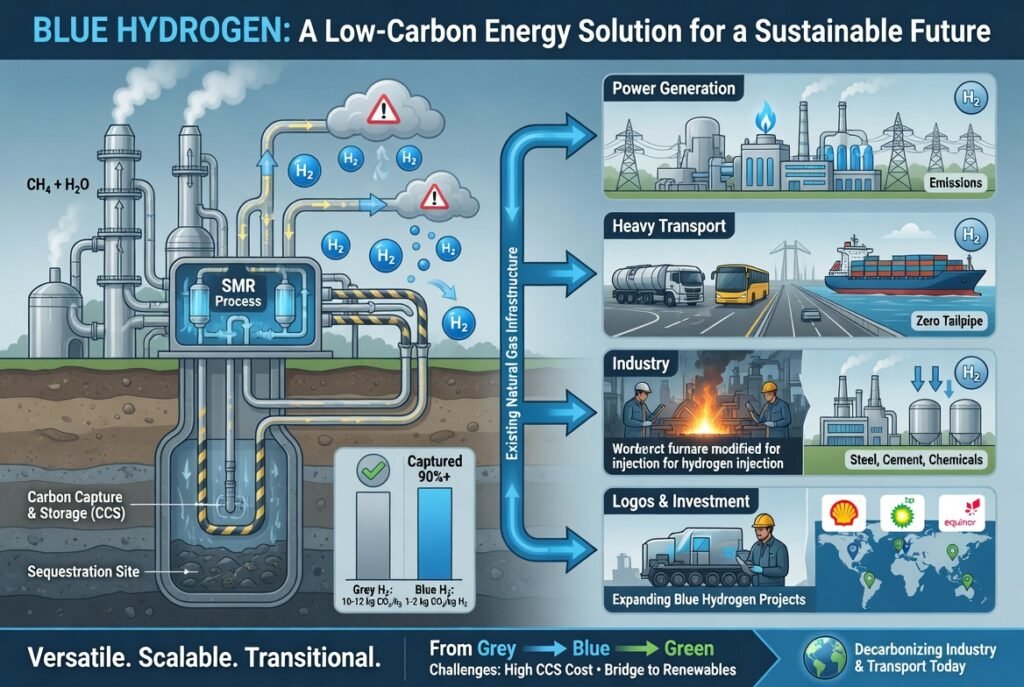
Blue Hydrogen: A Low-Carbon Energy Solution for a Sustainable Future is gaining worldwide attention as countries and industries search for cleaner energy alternatives that can reduce greenhouse gas emissions while maintaining reliable energy supplies. Produced primarily from natural gas using steam methane reforming (SMR) or auto-thermal reforming (ATR), blue hydrogen captures and stores most of the carbon dioxide generated during production through Carbon Capture, Utilization, and Storage (CCUS) technology. This process significantly lowers carbon emissions compared to conventional hydrogen production, making blue hydrogen an important bridge between today’s energy systems and a cleaner future.
As governments pursue net-zero emissions and industries seek practical decarbonization solutions, blue hydrogen is becoming an increasingly valuable component of global energy strategies.
Blue Hydrogen: A Low-Carbon Energy Solution for a Sustainable Future in Reducing Carbon Emissions
One of the greatest advantages of Blue Hydrogen: A Low-Carbon Energy Solution for a Sustainable Future is its ability to reduce greenhouse gas emissions from sectors that are difficult to electrify. Heavy industries such as steel manufacturing, cement production, petrochemicals, fertilizer manufacturing, and oil refining require high-temperature energy that electricity alone cannot always provide efficiently.
By capturing most carbon dioxide emissions during hydrogen production, blue hydrogen enables industries to lower their environmental impact while maintaining stable production. This helps businesses meet environmental regulations and climate commitments without sacrificing productivity.
Blue Hydrogen: A Low-Carbon Energy Solution for a Sustainable Future for Industrial Applications
Industrial sectors are among the largest consumers of energy worldwide. Blue Hydrogen: A Low-Carbon Energy Solution for a Sustainable Future offers a practical fuel for industrial boilers, furnaces, turbines, and manufacturing processes requiring continuous high-temperature heat.
Many existing industrial facilities can integrate hydrogen technologies while gradually reducing dependence on coal, diesel, and other fossil fuels. This transition improves sustainability without requiring complete replacement of existing infrastructure.
Blue Hydrogen: A Low-Carbon Energy Solution for a Sustainable Future and Energy Security
Energy security is another major benefit of Blue Hydrogen: A Low-Carbon Energy Solution for a Sustainable Future. Because blue hydrogen production uses existing natural gas infrastructure, many countries can expand hydrogen production without waiting for entirely new energy systems to be built.
Hydrogen can also be stored for long periods and transported through pipelines or specialized storage facilities. This flexibility improves energy reliability and helps balance electricity systems that increasingly depend on renewable sources such as solar and wind.
As renewable energy production fluctuates with weather conditions, hydrogen provides valuable long-term energy storage and backup power.
Environmental Benefits of Blue Hydrogen
The environmental advantages of Blue Hydrogen: A Low-Carbon Energy Solution for a Sustainable Future extend beyond reducing carbon emissions. Cleaner industrial fuel use improves air quality by lowering emissions associated with conventional fossil fuels. Reduced greenhouse gas emissions also contribute to slowing climate change and protecting ecosystems.
When combined with renewable electricity and improved carbon capture technologies, blue hydrogen supports cleaner industrial development while helping countries achieve national climate goals.
Although carbon capture does not eliminate all emissions, it substantially reduces the environmental footprint of hydrogen production compared with traditional methods
Economic Benefits of Blue Hydrogen
Investment in Blue Hydrogen: A Low-Carbon Energy Solution for a Sustainable Future creates economic opportunities across multiple industries. Building hydrogen production facilities, carbon capture systems, transportation infrastructure, storage networks, and distribution systems generates skilled employment and attracts private investment.
Countries with abundant natural gas resources can leverage existing infrastructure to develop competitive hydrogen industries while preparing for future renewable hydrogen markets. Businesses adopting blue hydrogen may also improve their environmental reputation and strengthen relationships with investors and customers who value sustainability.
Challenges Facing Blue Hydrogen
Despite its advantages, Blue Hydrogen: A Low-Carbon Energy Solution for a Sustainable Future still faces important challenges. Carbon capture technology requires significant capital investment, and suitable geological storage locations are not available everywhere.
The overall environmental performance of blue hydrogen also depends on minimizing methane leakage during natural gas extraction and transportation. Continued improvements in methane management, carbon capture efficiency, and hydrogen infrastructure are essential for maximizing environmental benefits.
Supportive government policies, international cooperation, and continued technological innovation will play an important role in expanding blue hydrogen adoption.
Future Outlook for Blue Hydrogen
The future of Blue Hydrogen: A Low-Carbon Energy Solution for a Sustainable Future appears promising as global demand for low-carbon energy continues to increase. Governments around the world are investing in hydrogen strategies, research programs, and infrastructure projects designed to accelerate clean energy transitions.
Blue hydrogen is expected to complement renewable energy sources while supporting industrial decarbonization, clean transportation, electricity generation, and large-scale energy storage. As carbon capture technology becomes more efficient and production costs continue to decline, blue hydrogen will remain an important contributor to sustainable energy systems
Conclusion
Blue Hydrogen: A Low-Carbon Energy Solution for a Sustainable Future provides a practical pathway toward reducing carbon emissions while supporting reliable industrial energy production. Through carbon capture technology, cleaner manufacturing, improved energy security, and economic development, blue hydrogen helps bridge the gap between traditional fossil fuels and fully renewable energy systems. Continued investment, innovation, and responsible environmental management will strengthen its role in building a cleaner, more sustainable global energy future.