
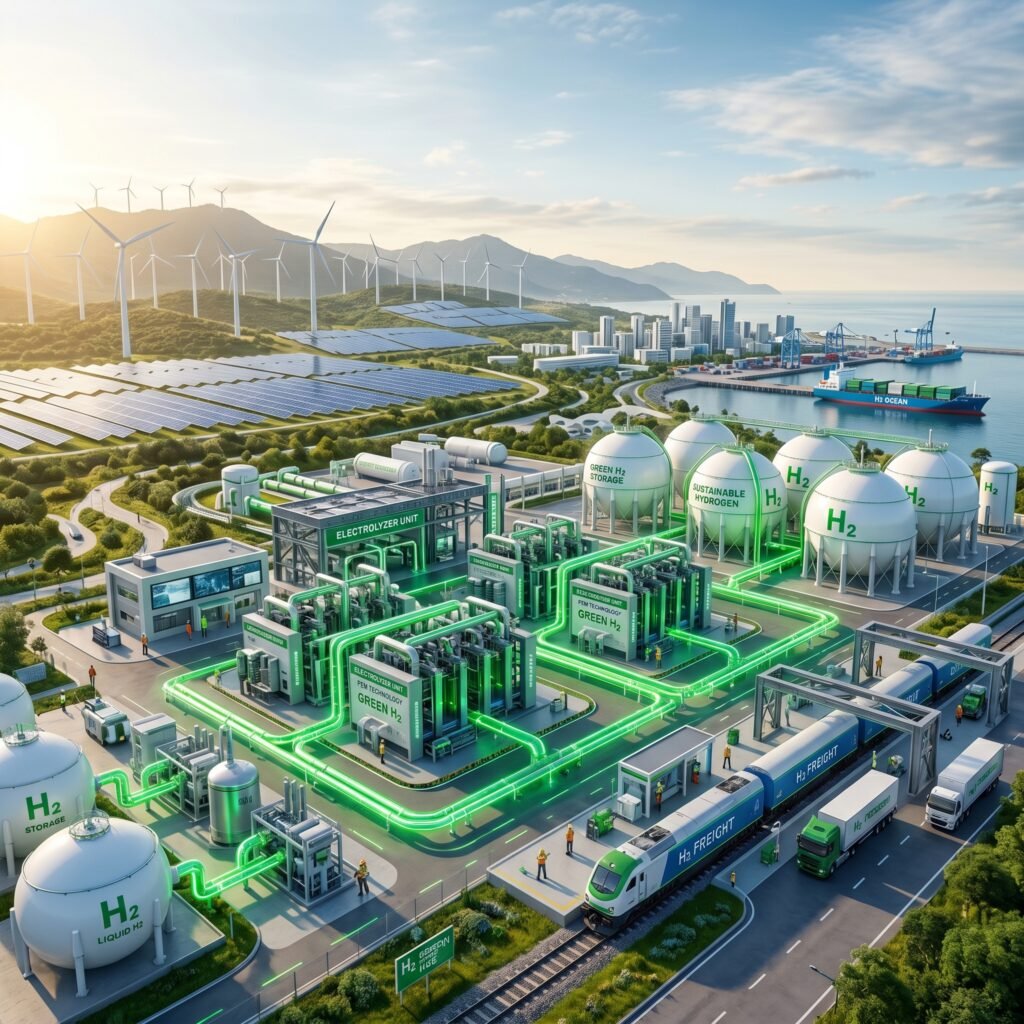
The green hydrogen economy is rapidly emerging as a cornerstone of the global transition toward clean, renewable energy. Produced through electrolysis powered by solar, wind, and other renewable sources, green hydrogen offers a zero-emission alternative to fossil fuels. As nations race to meet net-zero targets, this clean fuel is gaining momentum across industries, from heavy transportation and steel manufacturing to power generation and energy storage.
Current Market Trends in the Green Hydrogen Economy
Several powerful trends are accelerating the growth of the green hydrogen economy worldwide. Government policies and ambitious climate commitments are driving unprecedented investment, with the European Union, United States, Japan, Australia, and India all rolling out national hydrogen strategies. These initiatives include subsidies, tax incentives, and large-scale infrastructure projects designed to lower production costs and stimulate demand.
Falling renewable energy prices represent another major catalyst. As the cost of solar and wind power continues to decline, the economics of producing green hydrogen become increasingly favorable. Electrolyzer technology is also advancing quickly, with improved efficiency, larger production capacities, and reduced manufacturing costs making large-scale projects more viable than ever before.
Corporate participation is surging as well. Major energy companies, industrial manufacturers, and automotive firms are forming partnerships and securing long-term supply agreements. This private-sector engagement signals strong confidence in green hydrogen’s long-term role within the global energy mix.
Growth Forecasts Shaping the Future
Market analysts project explosive expansion for the green hydrogen sector over the coming decades. Industry forecasts suggest the global market could grow at a compound annual growth rate exceeding 30 percent through 2030, with valuations potentially reaching hundreds of billions of dollars. By 2050, green hydrogen is expected to supply a significant share of global energy demand, particularly in hard-to-decarbonize sectors.
Asia-Pacific is anticipated to dominate production and consumption, fueled by aggressive government targets in China, Japan, South Korea, and India. Meanwhile, Europe is positioning itself as a leader in technology development and cross-border hydrogen trade. The Middle East and Australia are emerging as major export hubs, leveraging abundant renewable resources to supply international markets.
Key Drivers Behind Market Expansion
The growth of the green hydrogen economy is supported by multiple structural drivers. Decarbonization mandates are pushing industries to seek viable alternatives to carbon-intensive processes. Steel, cement, ammonia, and chemical production—sectors that are difficult to electrify—are turning to hydrogen as a practical solution.
Energy security concerns are also reshaping national priorities. Countries seeking to reduce dependence on imported fossil fuels view domestic hydrogen production as a path toward greater independence. Additionally, the ability of hydrogen to store renewable energy and balance intermittent supply makes it a valuable component of modern power grids.
Challenges to Overcome
Despite optimistic forecasts, the green hydrogen economy faces notable hurdles. High production costs remain the primary barrier, though continued technological progress and economies of scale are steadily closing the gap with conventional alternatives. Limited infrastructure for transport, storage, and distribution also presents challenges that require substantial investment.
Regulatory uncertainty and the need for standardized certification systems can slow project development. Furthermore, scaling renewable electricity capacity to meet hydrogen demand without competing with other clean-energy needs will require careful planning and coordination.
The Road Ahead
The outlook for the green hydrogen economy remains overwhelmingly positive. As costs decline, technology matures, and supportive policies expand, green hydrogen is poised to become a vital pillar of the global clean-energy landscape. Strategic investments today are laying the foundation for a sustainable, low-carbon future powered by abundant renewable resources.
Businesses, governments, and investors that engage early stand to benefit from first-mover advantages in this transformative market. With strong momentum, accelerating innovation, and unwavering global commitment to decarbonization, the green hydrogen economy is set to redefine how the world produces and consumes energy in the decades to come.